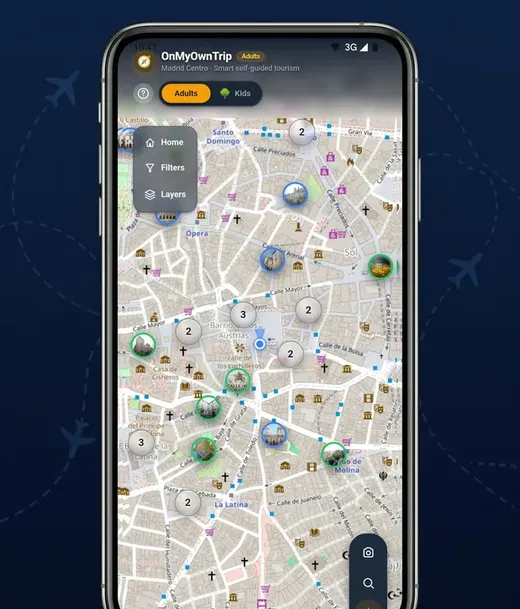
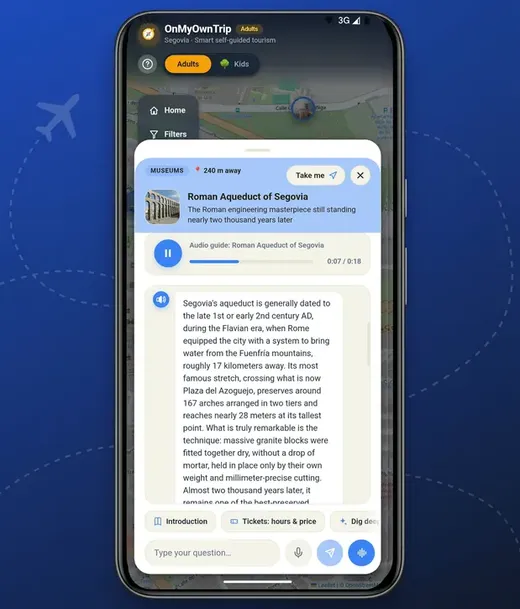
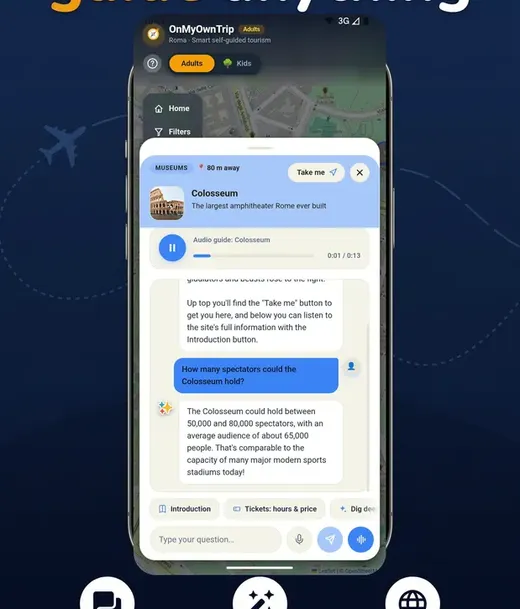
Download OnMyOwnTrip, pick Segovia and follow a route or wander freely: all 38 points of interest are free, each with its story narrated and an AI guide you can ask in front of every place.
How it works
1
Pick your route
Every stop on the map. Follow a recommended route or go in any order you like.
2
Listen to the story
Each place tells you its story in a natural voice as you walk, no screens to read.
3
Ask anything
An AI guide answers about what is in front of you: legends, fun facts, details.
Walking routes in Segovia
Approximate distances and times, including the stops and the narration.
Must-sees
10 stops7.1 km2 h approx.
The unmissable route through Segovia brings together the great symbols of this walled city perched on a rock between two rivers.
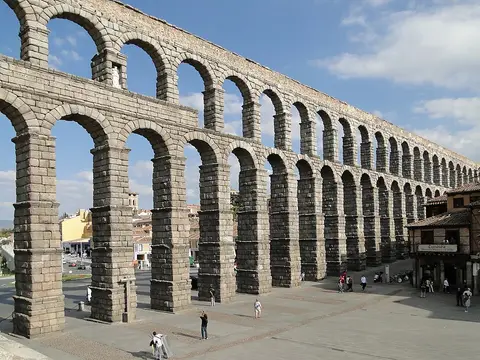
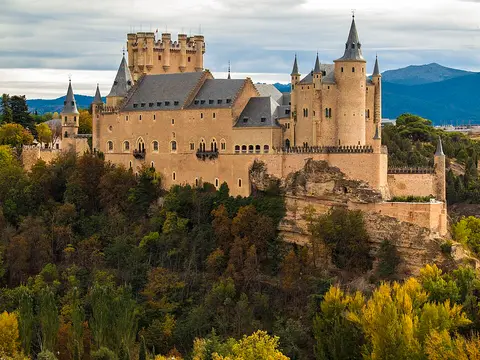
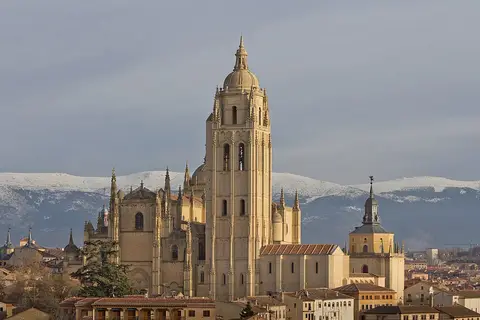
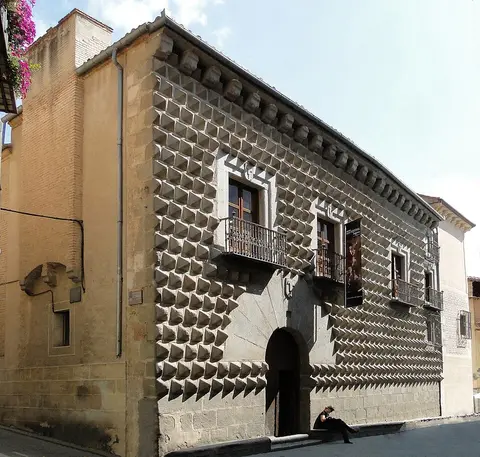
The unmissable route through Segovia brings together the great symbols of this walled city perched on a rock between two rivers. You'll start beneath the Roman Aqueduct, still standing without a single drop of mortar after almost two thousand years, climb up to the Alcázar, the fairy-tale castle where Isabella of Castile was proclaimed queen, and visit the Cathedral, the last great Gothic cathedral built in Spain. You'll cross Plaza Mayor, see the stone-studded facade of the Casa de los Picos, and finish at the old Main Synagogue, today a church, and the streets of the Jewish Quarter. By the end you'll have seen why the whole of Segovia is a UNESCO World Heritage Site.
Roman Aqueduct of Segovia
Alcázar of Segovia
Segovia Cathedral
Plaza Mayor of Segovia
Casa de los Picos
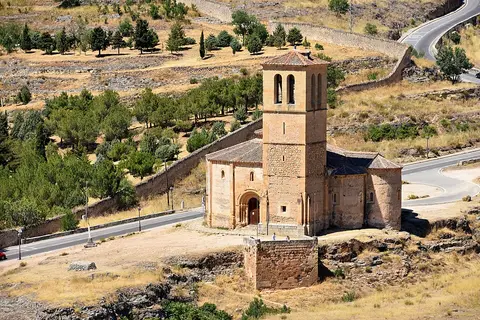
Church of the Vera Cruz
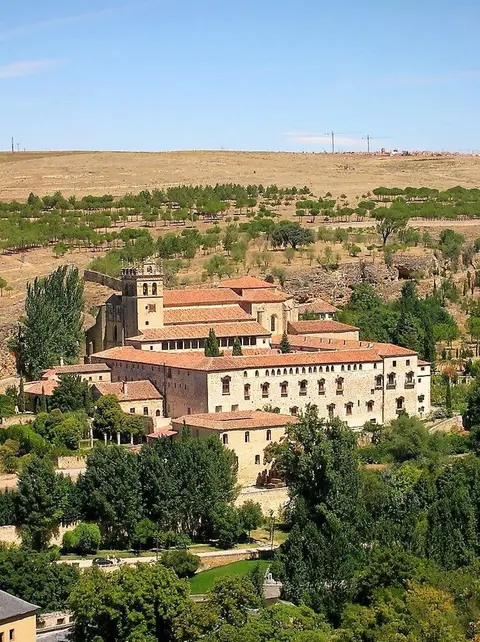
Monastery of El Parral
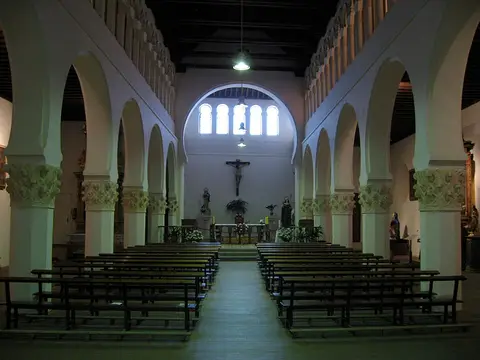
Church of Corpus Christi (Former Main Synagogue)
Segovia's Jewish Quarter
Royal Mint (Real Casa de la Moneda)
Jewish Quarter and City Walls
8 stops3.1 km1 h approx.
This route explores walled, Jewish Segovia, less photographed than the great monuments but just as fascinating.
This route explores walled, Jewish Segovia, less photographed than the great monuments but just as fascinating. You'll walk alongside the medieval wall that encircles the whole old town, pass through the San Andrés and Santiago gates, and wander the narrow streets of the old Jewish Quarter, home to one of Castile's most important Jewish communities until the 1492 expulsion. You'll visit the Torreón de Lozoya and Plaza de San Martín, and discover a Jewish cemetery on the El Pinarillo hillside.
City Walls of Segovia
Gate of San Andrés
Jewish Quarter Interpretation Center
Segovia's Jewish Cemetery (El Pinarillo)
Church of San Andrés
Gate of Santiago
Torreón de Lozoya (Lozoya Tower-House)
Plaza de San Martín
Eresma Valley
3 stops900 m30 min approx.
This route drops down from the walled city to the valley of the Eresma river, where Segovia hides some of its quietest corners.
This route drops down from the walled city to the valley of the Eresma river, where Segovia hides some of its quietest corners. You'll visit the Iglesia de la Vera Cruz, a twelve-sided Romanesque church linked to the Knights Templar, and the Monasterio de El Parral, founded in the 15th century beside the river. You'll cross a stone bridge with views up at the Alcázar from below, and finish at the Pradera de San Marcos, the classic postcard viewpoint of Segovia.
Church of San Juan de los Caballeros (Zuloaga Museum)
Convent of Santa Cruz la Real
Pradera de San Marcos Viewpoint
Romanesque Segovia
7 stops2.5 km45 min approx.
Segovia has nearly twenty Romanesque churches, an extraordinary concentration for a city its size, and this route covers the most notable ones.
Segovia has nearly twenty Romanesque churches, an extraordinary concentration for a city its size, and this route covers the most notable ones. You'll see the tower of San Esteban, considered one of the most beautiful in Spain, the almost-complete portico of San Martín, the medieval murals of San Justo, and the former church of San Quirce, today converted into an exhibition space. By the end you'll understand why Segovia is, alongside its aqueduct and its Alcázar, also a capital of Romanesque architecture.
Church of San Millán
Church of San Esteban
Church of San Martín
Church of San Justo
Church of San Clemente
Church of San Quirce
Church of San Lorenzo
Make the kids want to come too
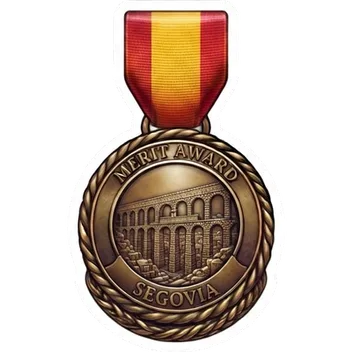
In kids mode, every stop has its own narration, a challenge and a quiz. Complete Segovia and they earn its medal.
All 38 points of interest in Segovia
See all 38 points of interest
Must-sees
Roman Aqueduct of SegoviaA Roman granite aqueduct built without a drop of mortar, its 167 arches still striding through the heart of Segovia.
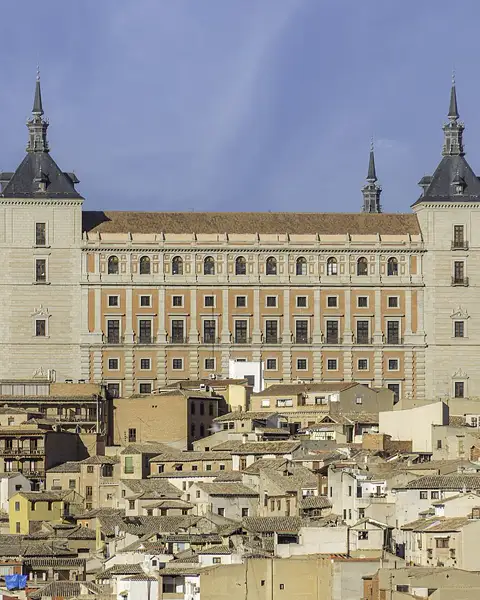
Alcázar of SegoviaA fortress on a rocky spur between two rivers where a queen was proclaimed, its pointed towers looking straight out of a fairy tale.
Segovia CathedralThe last great Gothic cathedral built in Spain, known as "the Lady of the Cathedrals" for its elegant proportions and towering spire.
Plaza Mayor of SegoviaSegovia's central square, framed by the Cathedral, the city hall and a century-old theatre, the city's social heart for generations.
Casa de los PicosA 15th-century noble house whose facade hides 617 hand-carved granite points, a one-of-a-kind decorative puzzle in Spain.
Church of the Vera CruzAn unusual twelve-sided church, consecrated in 1208, traditionally linked to the Templars, with a striking view of the Alcázar.
Monastery of El ParralA Hieronymite monastery founded in 1447 in a quiet valley below the Alcázar, with a carved altarpiece and its founders' tombs.
Church of Corpus Christi (Former Main Synagogue)The best preserved of Segovia's old synagogues, converted into a church in 1419 but with an interior that still breathes its Jewish origins.
Segovia's Jewish QuarterA maze of medieval streets preserving the urban layout of one of medieval Castile's most important Jewish communities.
Royal Mint (Real Casa de la Moneda)Founded in 1583 beside the Eresma, one of Europe's earliest industrial factories, where river water powered presses to strike coins.
Jewish Quarter and City Walls
City Walls of SegoviaAbout two miles of medieval wall, among the best-preserved town walls in Castile, still guard the rocky spur where Segovia was born.
Gate of San AndrésWith its two towers and the look of a small castle, this medieval gate was historically the main entrance into Segovia's Jewish quarter from outside the wall.
Jewish Quarter Interpretation CenterThis small interpretation center gathers maps, objects and explanations to understand daily life in Segovia's medieval Jewish quarter before exploring it.
Segovia's Jewish Cemetery (El Pinarillo)On this hillside known as El Pinarillo, overlooking the city, lies the old cemetery of Segovia's Jewish community, used until the 1492 expulsion.
Church of San AndrésBeside the San Andrés gate and the old Jewish quarter, this Romanesque-origin church has a tower whose lowest courses date to the 11th-12th centuries.
Gate of SantiagoThis medieval gate, named after a former church of Santiago, controlled access to walled Segovia and now houses the Peralta Puppet Collection.
Torreón de Lozoya (Lozoya Tower-House)This medieval tower-house, built as an urban stronghold by a noble family, is today a cultural venue beside Plaza de San Martín.
Plaza de San MartínOverlooked by the Church of San Martín and flanked by the Torreón de Lozoya, this square gathers some of Segovia's best-loved historic buildings.
Eresma Valley
Church of San Juan de los Caballeros (Zuloaga Museum)One of Segovia's oldest Romanesque churches, with a carved-capital portal, was bought in 1905 by the ceramicist Daniel Zuloaga, who turned it into a workshop, and is today the Zuloaga Museum.
Convent of Santa Cruz la RealRebuilt in Gothic style under the patronage of the Catholic Monarchs, this Dominican convent was historically linked to Tomás de Torquemada, its prior and first Grand Inquisitor.
Pradera de San Marcos ViewpointThis meadow at the foot of the Alcázar offers Segovia's most reproduced postcard view: the castle's silhouette against the sky, seen from below.
Romanesque Segovia
Church of San MillánWidely regarded as one of the finest examples of Segovian Romanesque architecture, San Millán keeps its 12th-century covered porticoes and carved capitals near the Aqueduct.
Church of San EstebanSan Esteban's slender, multi-level arcaded Romanesque tower is considered one of the most elegant in all of Spain.
Church of San MartínStanding at the center of its own square, San Martín preserves one of Segovia's most complete Romanesque porticoes and a tower blending Romanesque and Mudejar styles.
Church of San JustoSan Justo preserves rare Romanesque mural paintings of the Passion of Christ inside, along with a wooden crucifix tied to a deep-rooted local devotional tradition.
Church of San ClementeSan Clemente preserves its semicircular apse and Romanesque portico as a testament to the parish-building boom Segovia experienced in the 12th and 13th centuries.
Church of San QuirceLong deconsecrated, San Quirce preserves its 12th-century Romanesque structure and today functions as a cultural exhibition space.
Church of San LorenzoIn the Prado de San Lorenzo neighborhood, this Romanesque church shows how medieval Segovia grew beyond its own city walls.
More points of interest
Church of San Miguel16th-century church on Plaza Mayor, tied by long-standing historical tradition to the 1474 proclamation of Isabella I as queen.
Segovia City HallThe Herrerian granite building, the work of Pedro de Brizuela in the early 17th century, housing the municipal government, its arcade facing onto Plaza Mayor.
Juan Bravo TheatreA theatre opened in 1918 honoring the memory of Juan Bravo, the Segovian leader of the Comuneros revolt, executed in 1521.
Torreón de Arias DávilaOn the Plaza de los Huertos, this medieval tower was linked to the Arias Dávila, a powerful Segovian converso family, one of whose members was investigated by the Inquisition.
Mesón de CándidoBeside the Aqueduct, Cándido López turned this inn into a temple of roast suckling pig, famous for the tradition of carving it with the edge of a plate.
Mesón José MaríaNear the Plaza Mayor, Mesón José María shares with Cándido the fame of being one of the two must-visit addresses for Segovia's roast suckling pig.
Ponche SegovianoIn the pastry shops of the center you can try ponche segoviano, which began to be sold in 1926 at the confitería El Alcázar: marzipan cake filled with egg-yolk custard cream.
Palacio de QuintanarThis 16th-century Renaissance palace, built by Segovian nobility, hides a notable carved wooden artesonado ceiling inside.
Antonio Machado House-MuseumIn this modest boarding-house room, poet Antonio Machado lived from 1919 to 1932 while teaching French at a Segovia secondary school.
Paseo del SalónLaid out in the 19th century above the Clamores valley, Paseo del Salón carries the fame of once being one of Queen Isabella II's favorite places to stroll.
Frequently asked questions
Is the Segovia audio guide free?
Yes. All 38 points of interest, the map, the routes, the narration and kids mode are free. Premium only adds unlimited AI guide questions and unlimited visit plans.
Can I visit Segovia without a tour guide, at my own pace?
Yes. No schedules and no group: follow one of the recommended routes or go in any order, and the app tells you about each place when you pick it.
Is it good for visiting Segovia with kids?
Yes. Kids mode has its own narration, challenges and a quiz at every stop, plus a medal for completing the city.
Where do I get it?
The app is free on Google Play (Android) and the App Store (iPhone). Download it before your trip and it is ready to use in the city.
Segovia is waiting
Carry the audio guide in your pocket. Free, in English and Spanish.
 OnMyOwnTrip