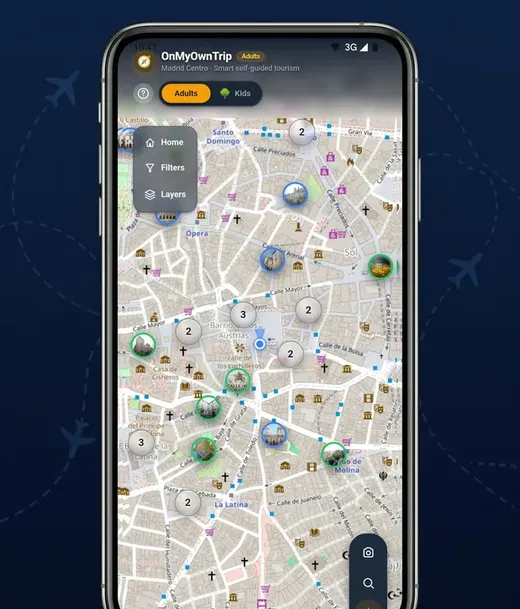
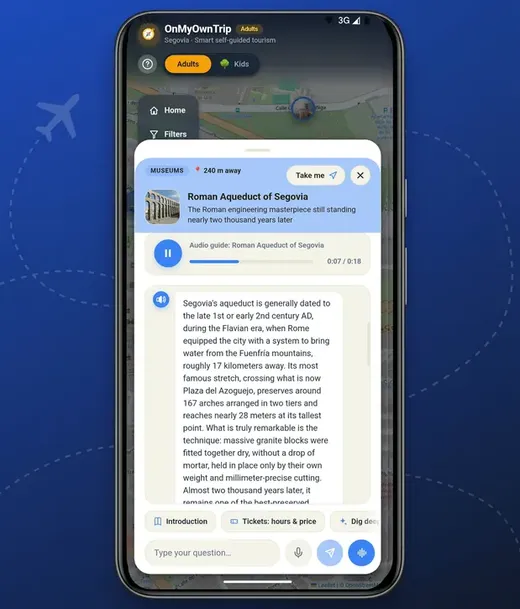
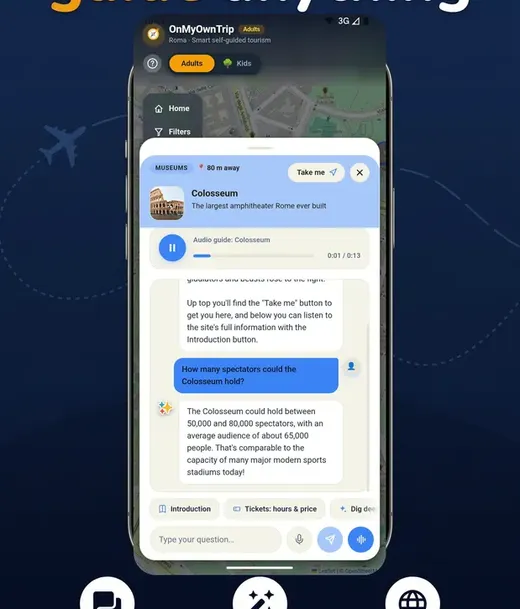
Download OnMyOwnTrip, pick Rome and follow a route or wander freely: all 39 points of interest are free, each with its story narrated and an AI guide you can ask in front of every place.
How it works
1
Pick your route
Every stop on the map. Follow a recommended route or go in any order you like.
2
Listen to the story
Each place tells you its story in a natural voice as you walk, no screens to read.
3
Ask anything
An AI guide answers about what is in front of you: legends, fun facts, details.
Walking routes in Rome
Approximate distances and times, including the stops and the narration.
Must-sees
7 stops5.1 km1 h 30 min approx.
Rome's essential route brings together the great symbols of almost three thousand years of unbroken history.
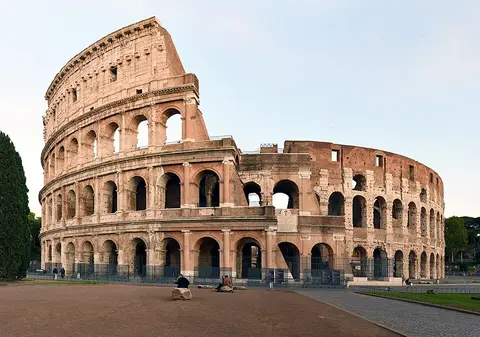
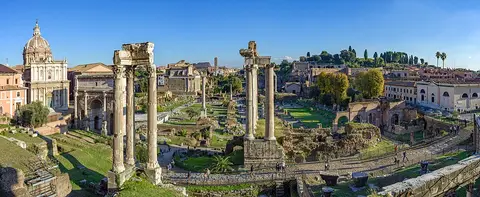
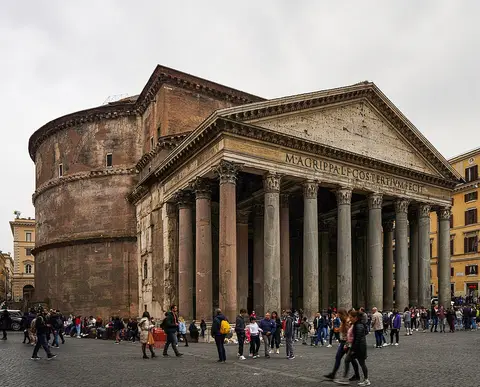
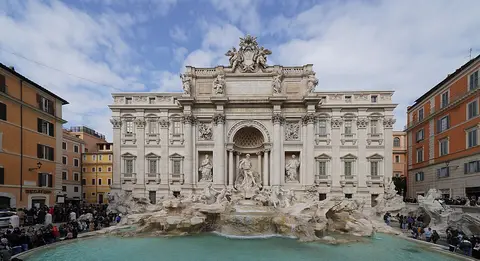
Rome's essential route brings together the great symbols of almost three thousand years of unbroken history. You'll start at the Colosseum, the most famous amphitheatre in the world, continue through the Roman Forum and the Palatine Hill, the political heart and residential quarter of ancient Rome, and cross over to the Pantheon, the largest unreinforced concrete dome ever built. You'll finish by tossing a coin into the Trevi Fountain and getting lost among the Bernini columns of Piazza Navona. Since this is a long route, some stretches are best covered by metro or at a brisk pace. By the end you'll understand why Rome is called the Eternal City: few places in the world let you walk, in a single morning, through the Empire, the Renaissance, and the Baroque without leaving the same old town.
Colosseum
Roman Forum
Pantheon
Trevi Fountain
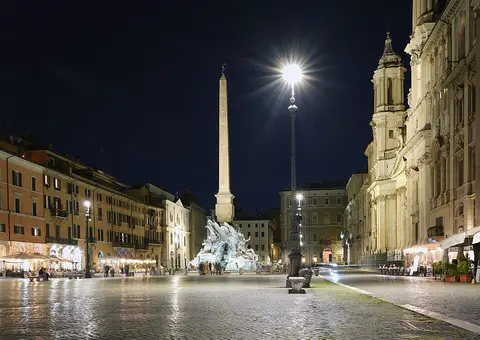
Piazza Navona
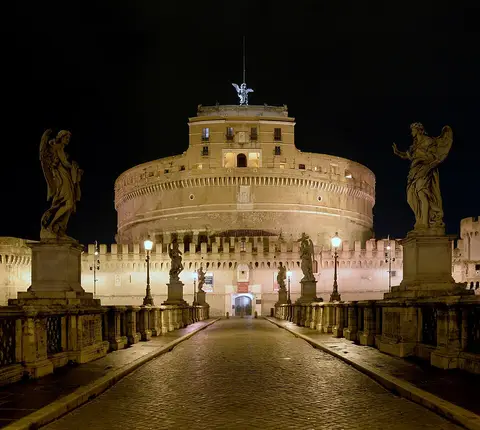
Castel Sant'Angelo
Ponte Sant'Angelo
Ancient & Imperial Rome
4 stops3.1 km45 min approx.
This route covers the heart of imperial Roman power, from the Colosseum to the Circus Maximus.
This route covers the heart of imperial Roman power, from the Colosseum to the Circus Maximus. You'll see the Arch of Constantine, the largest surviving triumphal arch in the city, walk down to the Circus Maximus, the hippodrome that once held 150,000 spectators, and visit the Bocca della Verità, the stone mouth that, according to legend, bites the hand of anyone who lies. You'll finish at the Baths of Caracalla, public baths so colossal that opera concerts are held among their ruins today. By the end you'll have walked, on foot, the very grounds that saw emperors, gladiators, and chariot races parade by two thousand years ago.
Arch of Constantine
Circus Maximus
Bocca della Verità
Baths of Caracalla
Trastevere & Hidden Rome
4 stops2.6 km45 min approx.
This route crosses to the other side of the Tiber, to Trastevere, Rome's most traditional and least monumental neighbourhood, perfect for wandering without a plan.
This route crosses to the other side of the Tiber, to Trastevere, Rome's most traditional and least monumental neighbourhood, perfect for wandering without a plan. You'll pass by the Isola Tiberina, the river's only island within the city, go into the Basilica of Santa Maria in Trastevere, one of the oldest churches dedicated to the Virgin Mary, climb up to the Gianicolo, a viewpoint with the best views over all of Rome, and finish at the Villa Farnesina, the Renaissance villa of a banker decorated by Raphael himself. By the end you'll have discovered that, just minutes on foot from the great monuments, Rome hides cobbled alleys, squares with modest fountains, and a neighbourhood life that has barely changed in centuries.
Isola Tiberina
Basilica of Santa Maria in Trastevere
Janiculum Hill
Villa Farnesina
A short walk away: Vatican City
Vatican City has its own route in the app: pick it in the city selector.
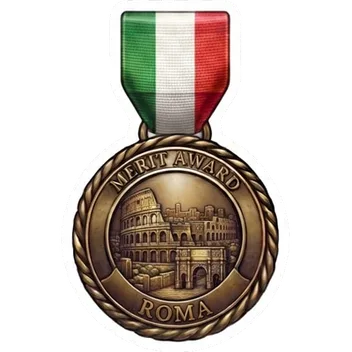
In kids mode, every stop has its own narration, a challenge and a quiz. Complete Rome and they earn its medal.
All 39 points of interest in Rome
See all 39 points of interest
Must-sees
ColosseumThe largest amphitheater Rome ever built, with a maze of tunnels under the arena where gladiators and beasts rose to the fight.
Roman ForumThe political and religious center of ancient Rome for nearly a thousand years, where Julius Caesar himself was cremated.
PantheonThe largest unreinforced concrete dome in the ancient world, with an oculus open to the sky that has never had glass.
Trevi FountainRome's largest Baroque fountain, fed by an aqueduct nearly 2,000 years old, where tossing a coin promises a return visit.
Piazza NavonaA Baroque square shaped long and narrow because it's literally built on top of an ancient Roman stadium.
Castel Sant'AngeloFrom Emperor Hadrian's mausoleum to a papal fortress, connected to the Vatican by a secret passage nearly 800 meters long.
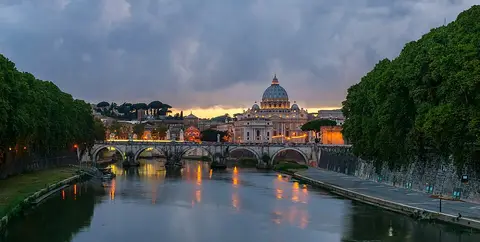
Ponte Sant'AngeloA Roman bridge nearly 2,000 years old, decorated with ten marble angels designed by Bernini, facing Castel Sant'Angelo.
Ancient & Imperial Rome
Arch of ConstantineThe largest surviving triumphal arch in Rome, decorated with recycled reliefs from earlier emperors to reinforce its legitimacy.
Circus MaximusAntiquity's largest chariot-racing venue, holding 150,000 spectators for roughly 1,100 years.
Bocca della VeritàAn ancient Roman drain cover that, according to medieval legend, bites the hand of anyone who lies while it's inside its mouth.
Baths of CaracallaFree, colossal public baths that held 1,600 bathers at once, with miles of slave tunnels running underground.
Trastevere & Hidden Rome
Isola TiberinaThe Tiber's only island, carved into a boat shape on purpose, devoted to healing for more than 2,300 years.
Basilica of Santa Maria in TrastevereOne of Rome's oldest churches dedicated to the Virgin Mary, with golden mosaics by Pietro Cavallini from the late 13th century.
Janiculum HillThe hill with Rome's best panoramic views, where a cannon still fires every noon out of pure tradition.
Villa FarnesinaThe villa of a super rich banker who impressed popes with banquets, decorated by Raphael himself.
More points of interest
Palatine HillThe hill where, according to legend, a she-wolf nursed Romulus and Remus before he founded Rome.
Piazza Venezia and Altare della PatriaRome's central square, presided over by a monument so white and enormous that Romans themselves nickname it "the wedding cake."
Piazza di Spagna and the Spanish StepsRome's most famous monumental staircase, with 135 steps paid for with French money despite its Spanish name.
Campo de' FioriA daily market since 1869, in the only large square in Rome without a church, and the site of Giordano Bruno's execution by fire.
Piazza del PopoloRome's grand northern gateway, with two churches that only look identical and an Egyptian obelisk of Ramesses II.
Capitoline Museums and Piazza del CampidoglioThe world's oldest public museum, in a square designed by Michelangelo, home to the legendary she-wolf of Romulus and Remus.
Basilica of Santa Maria MaggioreOne of Rome's four major papal basilicas, built where, according to legend, it miraculously snowed in the middle of August.
Basilica of St. John LateranRome's official cathedral, older than St. Peter's Basilica itself, where the Pope holds his true episcopal seat.
Fontana delle TartarugheA small Renaissance gem with four bronze turtles climbing toward the water, hidden in the heart of the old Jewish Ghetto.
Theater of MarcellusThe Roman theater that inspired the Colosseum's design, with a Renaissance palace, still inhabited today, built over its ruins.
Portico d'OttaviaThe monumental entrance to Rome's old Jewish Ghetto, whose Roman columns served for centuries as a fish market.
Domus AureaNero's extravagant palace, so vast it covered a third of Rome, buried underground by his own successors.
Basilica of San ClementeThree churches stacked in a single building, with a temple dedicated to the god Mithras at its deepest level.
Chiesa del GesùThe Jesuits' mother church, with a painted ceiling whose figures seem to literally spill into the interior of the church.
Sant'Ignazio di LoyolaA church with no money to build its dome, which solved the problem by painting one so realistic it fools everyone.
Galleria BorgheseOne of the world's best Baroque sculpture collections, with masterpieces by a young Bernini carved from stone that looks like flesh.
Fontana del TritoneThe first great public fountain designed entirely by Bernini, where a sea god blows water from a marble conch shell.
Ara Pacis AugustaeThe altar that celebrated the start of the Pax Romana, rescued centuries later by literally freezing Rome's subsoil.
Quartiere CoppedèA small neighborhood of architectural fantasy blending medieval, Baroque, and Art Nouveau styles, far from the tourist routes.
Buco della Serratura (Piazza dei Cavalieri di Malta)A tiny keyhole that perfectly frames St. Peter's dome, more than a kilometer away.
Giardino degli AranciA peaceful lookout among bitter orange trees, with one of Rome's most photographed sunset views.
Trajan's Column and Imperial ForumsA 30-meter column with a 190-meter spiral frieze carving an entire war in stone.
Palazzo FarneseOne of Rome's great Renaissance palaces, built by three great architects, today leased to France as its embassy.
Monte TestaccioAn artificial hill made from the remains of 53 million broken Roman amphorae, today Rome's culinary heart.
Vatican City
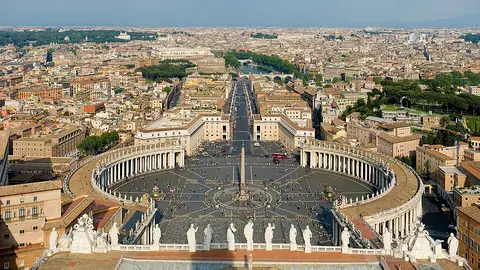
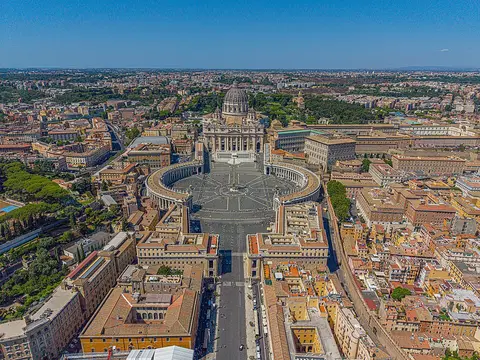
St. Peter's SquareAn elliptical square designed by Bernini as "the maternal arms of the Church," with a genuine Egyptian obelisk at its center.
St. Peter's BasilicaThe largest Catholic church in the world, built over the traditional tomb of St. Peter, crowned by Michelangelo's dome.
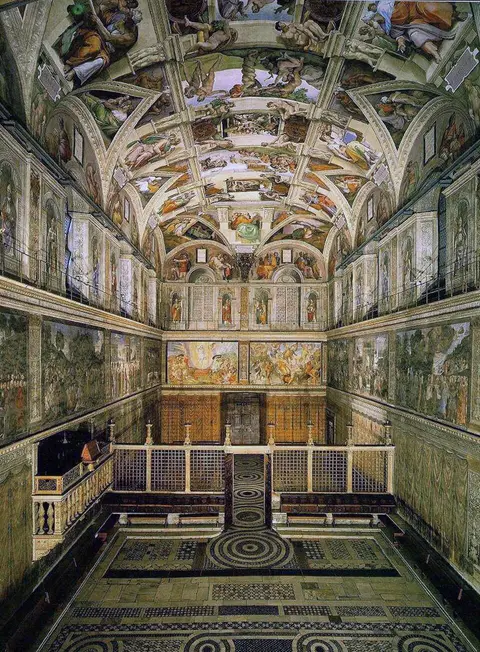
Vatican Museums and Sistine ChapelOne of the largest art collections in the world, home to the Sistine Chapel, where Michelangelo painted — almost reluctantly — his most famous work.
Frequently asked questions
Is the Rome audio guide free?
Yes. All 39 points of interest, the map, the routes, the narration and kids mode are free. Premium only adds unlimited AI guide questions and unlimited visit plans.
Can I visit Rome without a tour guide, at my own pace?
Yes. No schedules and no group: follow one of the recommended routes or go in any order, and the app tells you about each place when you pick it.
Is it good for visiting Rome with kids?
Yes. Kids mode has its own narration, challenges and a quiz at every stop, plus a medal for completing the city.
Where do I get it?
The app is free on Google Play (Android) and the App Store (iPhone). Download it before your trip and it is ready to use in the city.
Does the audio guide include Vatican City?
Yes. Vatican City has its own route in the app, with 3 stops: St. Peter's Square, St. Peter's Basilica, Vatican Museums and Sistine Chapel. Pick it in the city selector.
Rome is waiting
Carry the audio guide in your pocket. Free, in English and Spanish.
 OnMyOwnTrip